
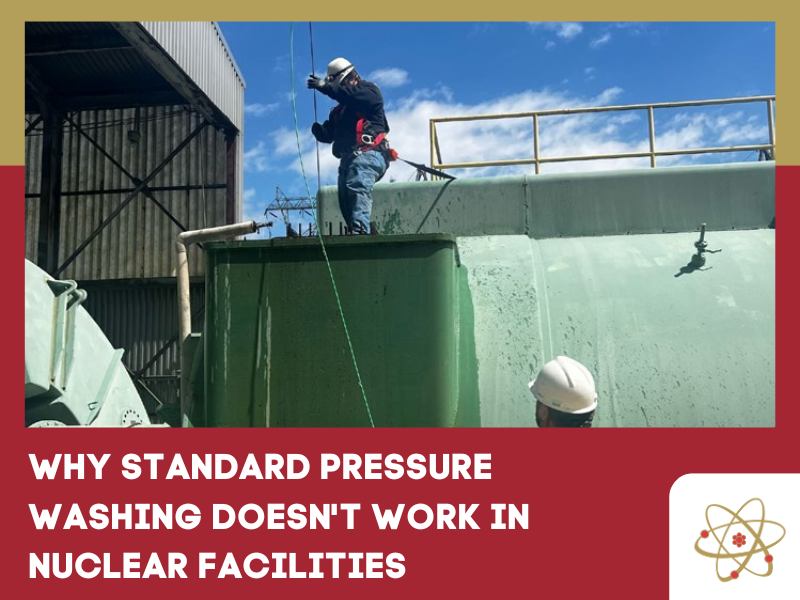
In the world of industrial maintenance, the word “clean” takes on a different meaning. For a residential property, a clean driveway is a matter of aesthetics. For a nuclear power plant, a fossil fuel facility, or a high-output manufacturing floor, “clean” is a matter of thermal efficiency, regulatory compliance, and multi-million dollar asset longevity.
Many facility managers initially turn to standard commercial pressure washing as a cost-effective solution. However, at the industrial scale, these standard methods don’t just underperform, they often fail. At The Merrick Group, we’ve spent over 30 years diagnosing why these common approaches fall short and implementing the advanced alternatives that actually deliver results.
Get a Nuclear Facility Maintenance Quote
The “Standard” Problem: Why PSI Isn’t Everything
Standard commercial pressure washing typically relies on two metrics: high PSI (Pounds per Square Inch) and cold water. While 3,000 to 4,000 PSI is enough to strip paint from a fence, it is often fundamentally ill-equipped for industrial environments for three key reasons:
1. The Surface-Level Limitation
Industrial fouling isn’t just “dirt.” It is a complex cocktail of baked-on carbon deposits, calcium carbonate scaling, chemical polymers, and heavy greases. Standard pressure washing often acts like a blunt instrument, it hits the surface hard but fails to penetrate the molecular bond of the contaminant. The result? A surface that looks clean to the naked eye but remains “fouled” at a performance level.
2. The Drainage and Secondary Waste Crisis
In an industrial setting, you cannot simply let thousands of gallons of runoff flow into a storm drain. Standard pressure washing creates massive amounts of secondary waste, contaminated water that must be captured, treated, and disposed of. If your cleaning method creates a secondary environmental hazard, the “cost savings” of a cheaper service are immediately wiped out by waste management fees and EPA risks.
3. Equipment Vulnerability
Modern industrial facilities are packed with sensitive sensors, electrical components, and precision-machined surfaces. Using high-pressure water around delicate gaskets or electronic controls is a recipe for catastrophic equipment failure. Brute force is rarely the answer when precision is required.
How the Merrick Group Cleans Industrial Facilities
True industrial cleaning requires a move away from “one-size-fits-all” washing toward specialized, high-tech methodologies. The Merrick Group provides hydrolazing services, operating at pressures up to 40,000 PSI, this process uses specialized rotary nozzles and computer-controlled delivery systems. Unlike manual pressure washing, hydrolazing is surgical. It can strip internal pipe scaling, clean heat exchanger tubes to “near-new” condition, and restore flow efficiency that standard washing simply cannot touch.
In addition to hydrolazing, we utilize hydro blasting as a high-efficiency, volume-based method for large-scale heat exchanger and condenser maintenance. Rather than relying solely on extreme pressure, this technique uses a high flow of water to drive specialized projectiles through the tubing to mechanically strip away deposits. These projectiles are never “one-size-fits-all”; they are chosen specifically for a piece of equipment, ensuring a comprehensive clean.
Get a Nuclear Facility Maintenance Quote
Get Professional Nuclear Facility Cleaning with Merrick
Standard pressure washing is a service; industrial decontamination is a strategy. When you choose an industrial-grade partner like The Merrick Group, you aren’t just paying for a cleaner facility, you are investing in:
- Reduced Heat Rate: Restoring thermal efficiency in power generation.
- Minimized Downtime: Faster cleaning cycles during outages.
- Regulatory Peace of Mind: Full compliance with safety and environmental standards.
Contact The Merrick Group today to discuss a customized industrial cleaning solution that goes beyond the surface.